

In the high-stakes world of professional tennis, few figures command as much quiet respect in the player’s box as Alexander Zverev Senior. While the global spotlight often falls on his son, the Olympic Gold Medalist and ATP superstar Alexander “Sascha” Zverev, the elder Zverev remains the stoic architect behind the scenes. He is not merely a supportive parent but a former professional player and a high-level tactician who built one of the modern game’s most formidable talents from the ground up. To understand the success of Germany’s top-ranked player, one must understand the man who laid the foundation: Alexander Zverev Senior.
Who Is Alexander Zverev Sr.?
To appreciate his coaching prowess, it is essential to look back at the origins of Alexander Zverev Senior, whose life journey bridged the gap between the Soviet Union and modern Germany.
Early Life, Nationality and Tennis Background
Born in Sochi in 1960, Alexander Zverev Senior grew up in the Soviet Union during an era where sport was a primary vehicle for national pride. He developed his skills within the rigorous Soviet sports system, which prioritized discipline and technical perfection. In 1991, amidst the geopolitical shifts in Europe, he and his wife, Irina Zvereva—also a professional tennis player—immigrated to Germany. They settled in Hamburg, where they began a new life as tennis coaches, bringing with them a wealth of Eastern European tennis philosophy that would later shape their sons’ careers.

Professional Career as a Tennis Player
Before he was a renowned coach, Alexander Zverev Senior was a formidable competitor in his own right. He represented the Soviet Union in the Davis Cup and was a top-ranked player nationally. On the international circuit, he reached a career-high ATP ranking inside the top 175. While his playing career was somewhat limited by the travel restrictions and political climate of the Soviet era, his experience competing at major tournaments like Wimbledon gave him invaluable insights into the professional game—insights he would later pass down to Mischa and Sascha.
Alexander Zverev Senior as a Tennis Coach
Transitioning from player to mentor, Alexander Zverev Senior developed a reputation for a coaching style that blends traditional discipline with technical mastery.
Coaching Philosophy and Training Methods
The coaching philosophy of Alexander Zverev Senior is rooted in the “old school” approach: repetition, discipline, and grueling physical conditioning. Unlike many modern coaches who rely heavily on video analytics and data science, Zverev Senior trusts his eyes and his instincts. He emphasizes perfect biomechanics, ensuring that a player’s shots are not just effective but sustainable over a long career. This focus on technical purity is evident in Sascha’s two-handed backhand, widely considered one of the best and most technically sound shots in tennis history.
Building a Family-Based Training System
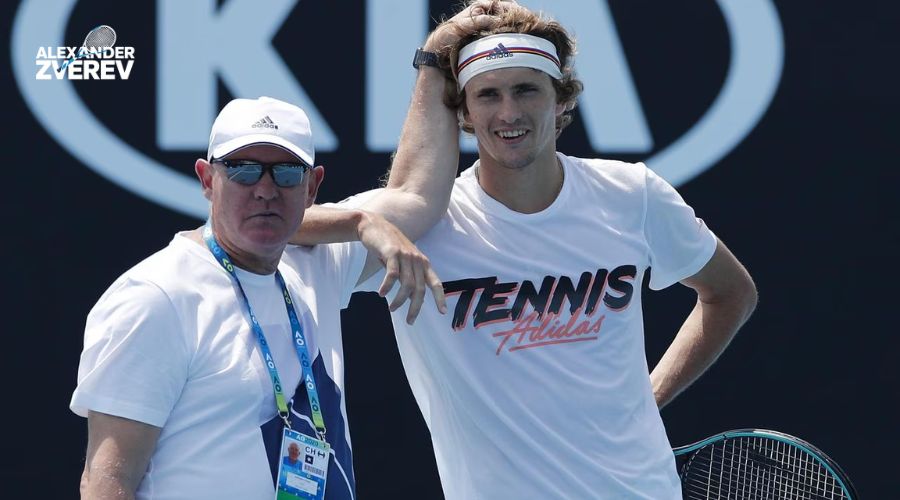
Alexander Zverev Senior operates within a unique, tight-knit family system. He serves as the head coach, maintaining a professional distance on the court while being a father off it. This “family coaching” model has its challenges, but for the Zverevs, it provides an unmatched level of trust. While other “super coaches” like Juan Carlos Ferrero or Ivan Lendl have joined the team at various points, Alexander Zverev Senior has always remained the constant anchor, ensuring the core training values are never compromised.
Role in Alexander Zverev’s Development
The meteoric rise of Sascha Zverev is the direct result of a decades-long project helmed by his father.
Early Training Years and Junior Career Guidance
Alexander Zverev Senior placed a racket in Sascha’s hands as a toddler. Recognizing his younger son’s exceptional height and athleticism, he tailored a development plan that prioritized movement and coordination—areas often neglected in tall players. He guided Sascha through the junior circuit with military precision, culminating in Sascha becoming the World No. 1 Junior and winning the Australian Open Boys’ title. Every step was calculated by Senior to ensure no burnout occurred before the professional transition.
Transition From Junior to ATP Tour
The jump from juniors to the ATP Tour is where most talents fail, but Alexander Zverev Senior navigated this expertly. He focused on toughening Sascha mentally and physically for the grind of the pro tour. He managed the schedule carefully, mixing Challenger events with ATP qualifiers to build confidence. Crucially, during the early years of losses and physical growth spurts, Senior provided the emotional stability and tactical adjustments that allowed Sascha to break into the Top 10 at a remarkably young age.
Relationship With Mischa Zverev and Family Tennis Legacy
One of Alexander Zverev Senior‘s most underrated achievements is his ability to coach two sons with completely different playing styles.
Coaching Both Sons – Similarities and Differences
While Sascha is a powerful baseliner, his older brother Mischa Zverev is a classic serve-and-volley player. Alexander Zverev Senior demonstrated incredible versatility by coaching Mischa to a Top 25 ranking using a net-rushing strategy, while simultaneously molding Sascha into a baseline dominator. This ability to adapt his coaching methodology to the specific strengths and weaknesses of each individual proves that Senior is not a “one-trick pony” but a master tactician.
The Zverev Family as a Tennis Dynasty
Together, under the guidance of Alexander Zverev Senior, the family has become a dynasty in German tennis. They are often compared to other famous tennis families, but the Zverevs are unique in their longevity and consistent presence at the top level. The image of the father sitting stoically in the box while his sons battle on court has become iconic, symbolizing a successful integration of family bonds and professional ambition.
Public Image, Media Presence and Influence
Despite his immense success, Alexander Zverev Senior remains an enigma to the general public.
Public Perception and Media Appearances
Alexander Zverev Senior is famously media-shy. He rarely gives interviews and prefers to let his sons’ rackets do the talking. On camera, he is often seen with a serious, intense expression, analyzing every point. This has cultivated an image of a stern taskmaster, but those close to the family describe him as a deeply caring figure who protects his sons from the relentless media scrutiny.
Influence on German Tennis Culture
The impact of Alexander Zverev Senior on German tennis cannot be overstated. Following the golden era of Boris Becker and Steffi Graf, German tennis experienced a lull. Senior’s work in producing two top-tier players revitalized the sport in the country. He is viewed by the German tennis federation and fellow coaches as a model of dedication, proving that world-class players can still be developed within a private, family-centric structure.
Legacy and Long-Term Impact
As Alexander Zverev continues to chase Grand Slam glory, the legacy of his father is already cemented.
Coaching Legacy Beyond Trophies
The true success of Alexander Zverev Senior is not just measured in the Olympic Gold or ATP Finals trophies his son has lifted. It is measured in the resilience and technical solidity of his players. He instilled a work ethic that allows Sascha to recover from career-threatening injuries and return to the Top 2. This legacy of discipline is a blueprint for aspiring tennis parents and coaches worldwide.
Alexander Zverev Senior’s Place in Tennis History
When history books record the era of the “Next Gen” talents who challenged the Big Three, Alexander Zverev Senior will be remembered as a key protagonist. He is the quiet force who engineered the game of one of the world’s best players. Whenever fans search for the secret behind Sascha’s backhand or his tactical resilience, the answer inevitably leads back to one man: his father and coach, Alexander Zverev Senior.

Hi, this is a comment.
To get started with moderating, editing, and deleting comments, please visit the Comments screen in the dashboard.
Commenter avatars come from Gravatar.